




GDPR: Securely storing, archiving, and destroying customer data
Which documents containing customer data require special protection, how long they may be stored, and why a filing safe for data media is insufficient.
The General Data Protection Regulation (GDPR) came into effect on May 25, 2018. It contains fundamental changes regarding the collection, storage, and processing of personal data. Non-compliance can result in fines of up to 20 million euros or 4 percent of annual global turnover. Since then, the storage and security of customer-related data in particular must be organized more sensitively. This guide summarizes what you should consider when keeping data.
Storage of paper documents
Documents containing personal data should be destroyed as far as possible as soon as they are no longer strictly required. Tax-related documents such as invoices containing customer data are exempt from this: in accordance with § 147 of the German Fiscal Code (Abgabenordnung), they must be kept for ten years. Caution is also advised with paper documents such as contracts, employee data, material slips, and time sheets.
According to a Bitkom study, the majority of processes in small and medium-sized enterprises are paper-based. 20 percent of documents in all German businesses exist exclusively in paper form.
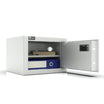
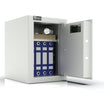
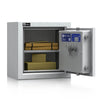
These paper documents must be demonstrably protected against access by unauthorized persons. To meet these requirements, storing sensitive data in a security safe is essential. Bremer Tresor offers you a multitude of document safes that feature certified burglary protection.
For the storage of documents that must be archived over a longer period, a fireproof document safe is recommended. This safe offers tested fire protection that reliably prevents the destruction of paper in the event of a fire due to flames, heat, smoke, or extinguishing water. The overview of fire protection classes shows which level is sufficient for what.
Destruction of paper documents
Physical data, just like digital data, must be demonstrably and irretrievably destroyed in order to guarantee the protection of personal data.
Personal data must be processed in a manner that ensures appropriate security of the personal data, including protection against unauthorized or unlawful processing and against accidental loss, destruction or damage, using appropriate technical or organizational measures.
In addition, there is the storage limitation according to Art. 5 (1) (e): Personal data may only be stored in an identifiable form for as long as is necessary for the purpose. The controller is responsible for compliance and must be able to demonstrate it.
Storage of digital documents
We recommend that you store all storage media in a safe once the work process is complete. In this way, data carriers can be easily kept in file cabinets to prevent access to sensitive data.
Another option is to store the data carriers in a data safe. This offers reliable protection for USB sticks, hard drives, data tapes, or CDs in the event of a fire.
Unsure which safe is sufficient for your documents?
Whether paper files, data carriers, or both: we will assess your case and tell you the appropriate fire protection class along with suitable models.


