


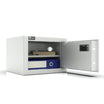
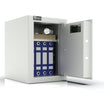
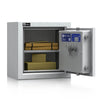


Have your safe anchored: Professionally, with certification
We will inspect your structural conditions and professionally secure your safe to the floor and wall, including certification for your insurance provider.
Enquire without obligationAnchoring your safe: Professional work with certification
Safes with a lower weight should always be anchored, as burglars are constantly finding new ways to transport them, if necessary with the help of lubricants or rollers. It is therefore extremely important to securely fasten your safe by having it anchored. This is not only important to deter a potential thief, but also plays a major role in terms of insurance coverage. Insurance companies recommend always anchoring safes weighing up to 1000 kg. Furthermore, they often require proof of professional anchoring. We are happy to advise you on safe anchoring and assess your individual circumstances to fasten your safe to the floor and wall.
Have the safe anchored: everything from a single source


Location-specific material and installation
Location-specific material
The location of the safe is a crucial criterion for anchoring. Above all, attention must be paid to the material of the floor and walls. (Crack-free) concrete provides an ideal basis for both wall and floor mounting, but anchoring can also be implemented with other materials. Anchoring should be avoided with screed or plasterboard. Additionally, it is important to ensure beforehand where power and water lines are located.
Depending on the location, materials, and personal preferences, we use different fastening options. A special type of mounting can be achieved, for example, through an embedded flush-mounted safe.
Installation
Most safes already have one or two pre-drilled holes for floor mounting, and some have one or two in the back panel for wall anchoring. If this is not the case, we can perform the drilling subsequently without compromising the security level.
Plastic anchors are completely unsuitable for fastening; instead, special heavy-duty anchors are usually used, which can often be purchased along with the safe. Alternatively, the use of a threaded rod is also possible. While heavy-duty anchors are suitable exclusively for concrete, threaded rods can be used more flexibly. For brick and stone walls, adhesive anchors are also an option for fastening the safe.
Have the safe anchored in four safe steps
Enquire now without obligation
Tell us briefly what you need. We’ll get back to you with a quote. Not sure of the exact weight or model? No problem, we’ll work it out together over the phone.

- Experienced team, the right equipment
- Professional, clean and discreet
- Transparent fixed-price quote
- Across Germany, since 1978
Tensile strength and insurance
Tensile strength
Tensile strength plays a decisive role in safe anchoring. It indicates the maximum load a material can withstand and is defined as force per unit area. It can therefore be used to derive when a safe made of a specific material and with a specific cross-section will fail under tensile stress. For this reason, the material properties of the floor and wall are extremely important.
Insurance
For safes built according to the EN 1143-1 standard, there is specific anchoring material that should be used exclusively. However, in some cases, this is not possible: for example, if your substrate is not compatible and a different type of anchoring is necessary. You should clarify this in writing with your insurance provider before fastening the safe to ensure your coverage remains fully intact in any event. We are also happy to assist you with special circumstances regarding anchoring to find an individual solution for you and your insurance provider.
Please contact us; you can find all ways to get in touch on our contact page.
Frequently asked questions
At what weight should a safe be anchored?
Which surface is suitable for anchoring?
What happens if my safe does not have drill holes?
What mounting material is used?
Do I have to coordinate the anchoring with my insurance company?
What do I have to pay attention to before drilling?


Ready to move your safe securely?
Send your enquiry in under a minute, or call us directly. We’ll take care of the rest.