


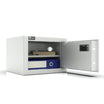
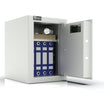
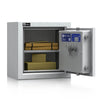


Safe security level B: construction according to VDMA 24992
 EN-Zertifizierte Tresore
 Versicherbar nach Widerstandsgrad
 Beratung zur Versicherungssumme

Ceres 30 - Furniture Safe Security Level B and S2 - (30 x 42 x 38cm)
Ceres


Ceres 40 - Furniture Safe Security Level B and S2 - (42 x 30 x 38cm)
Ceres


Merkur 15 - Furniture Safe Security Level B - (18 x 31 x 24cm)
Merkur


Ceres 60 - Furniture safe security level B and S2 - (61 x 43 x 38cm)
Ceres


Eris 20S - Furniture safe security level S1 - (20 x 32 x 20cm)
Eris


Ceres 25 - Furniture safe, security levels B and S2 - (25.5 x 39.5 x 38cm)
Ceres


Merkur 25 - Furniture Safe Security Level B - (28 x 31 x 24cm)
Merkur


Ceres 70 - Furniture safe security level S2 - (71 x 43 x 38cm)
Ceres


Eris 25 - Furniture safe security level S1 - (25 x 34 x 29cm)
Eris


Ceres 80 - Furniture Safe Security Level S2 - (81 x 43 x 38cm)
Ceres


Eris 20 - Furniture Safe Security Level S1 - (19 x 38 x 37.5cm)
Eris


Eris 30 - Furniture Safe Security Level S1 - (30 x 44 x 36.5cm)
Eris


Eris 40 - Furniture Safe Security Level S1 - (38 x 38 x 37.5cm)
Eris


Eris 45 - Furniture Safe Security Level S1 - (46 x 44 x 36.5cm)
Eris


Eris 50 - Furniture safe security level S1 - (48 x 38 x 37.5cm)
Eris


Merkur 45 - Furniture safe security levels B and S2 - (44 x 43 x 24cm)
Merkur


Eris 70 - Furniture Safe Security Level S1 - (73 x 38 x 37.5cm)
Eris


Hermes 195 - Document safe security level S2 - (195 x 70 x 50cm)
Hermes


Hermes 125 - Document Safe Security Level S2 - (125 x 70 x 50cm)
Hermes


Hermes 100 - Document Safe Security Level S2 - (100 x 70 x 50cm)
Hermes


Apis 190 - Fireproof safe 60 minutes - (189 x 89 x 45cm)
Apis


What is security level B?
Safes that only have security level B do not meet any official certification. The guidelines for this security level relate only to the construction of the safe, but do not attest to its quality. Due to defects in safes that comply with these guidelines, the VDMA 24992 standard sheet, which contained the construction specifications for safes with security level B, was withdrawn without replacement (Read The history of the VDMA 24992 standard sheet). The guidelines were replaced by the European guidelines EN 14450. We offer safes that meet the guidelines of security level B and possess EN 14450 certification. Since many insurance companies still rely on the VDMA guidelines, we verify that our models continue to comply with the guidelines of security grade B. This is to ensure they also meet current security standards of the ECB-S (European Certification Board - Security Systems) and their guidelines for insurance coverage amounts. This way, you can be sure that you will meet the requirements of your property insurer in any case. We strongly advise against purchasing a safe with security level B that does not have EN 14450 certification. With S2 certification, you are entitled to insure valuables in the cabinet up to €20,000.00 for private use. According to the old VDMA guidelines, you are entitled to insure up to €40,000.00 for private use if the weight is 200 kg or more. Clarify the requirements with your property insurer.
The difference between security level S2 and B
The major difference between the security levels is the procedure for quality testing. While safes with class B must comply with certain construction guidelines and can then be self-certified by the manufacturer, obtaining certification according to class S2 requires extensive testing by public testing bodies.
Therefore, not only the construction of the body and the door is monitored, but the entire safe is tested for burglary resistance. In comparison to the VDMA guidelines, EN 14450 certifications prove a security unit against not only mechanical but also thermal breaching tools. A product series with EN 14450 certification must be tested semi-annually to counteract any loss of quality during production.
Additional fire protection
Thanks to our wide range, you have the option of obtaining a class B safe with a certain level of fire protection. We offer class B safes without fire protection, with light fire protection, and with heavy-duty fire protection. There are also official certifications for fire protection as proof of quality testing. These certifications comply with EN 15659 for light, and EN 1047-1 for heavy-duty fire protection. The certifications are named LFS30P, S60P, and S120P, with the number indicating the duration in minutes of the completed fire test. A fire test is performed at over 1000°C (More info in the "fireproof safes" category)
- No fire protection
- No fire protection certification
- Light fire protection
- LFS30P according to
EN 15659 - Heavy-duty fire protection
- S60P or S120P according to
EN 1047-1
The history of the VDMA 24992 standard sheet
The guidelines of standard sheet 24992 were initiated in May 1995. The Association of German Machinery and Equipment Manufacturers (VDMA), essentially an association of safe manufacturers, recognized that there had to be uniform guidelines for the production of steel cabinets and safes. The VDMA 24992 guidelines required that the body of a steel cabinet must have 2 steel sheets with a total thickness of 4.5mm and a total wall thickness of 60mm. The cavity between the walls of 55.5 mm had to be filled with a heat-resistant insulating material. To ensure more security, it began to be filled with concrete, which greatly increased the stability of the two sheets. Since these steel cabinets exceeded the security-related quality of security level B safes using insulating material, this quality was also meant to be demonstrated to insurers. Because concrete is considerably heavier than other insulating materials, insurance amounts were linked to the weight. Security level B safes with a weight of more than 200kg were to be insurable up to a value of €40,000.00 for private use. Safes with security level B and a weight of more than 300kg were to be insurable up to €10,000.00 for commercial use. This classification led to safes being built with ballast weights to achieve these weights. This, of course, did not achieve the desired goal, and the quality of safes with security level B decreased until evidence of the inferior quality led to the VDMA 24992 standard sheet being withdrawn in January 2004.
- November 1892
- Foundation of the VDMA in Cologne
- May 1995
- Establishment of the construction regulation VDMA 24992
- January 2004
- Abolition of the construction regulation VDMA 24992
- February 2004
- Replacement by the European security standard
EN 14450
Official statement from the VDMA
After it was proven that steel cabinets complying with the VDMA 24992 guidelines were in some cases unable to withstand even light burglary tools, the VDMA 24992 standard sheet was withdrawn. The VDMA acknowledged the deficiency and withdrew the VDMA 24992 standard sheet in January 2004 without replacement. You can view the statement at the following link: Press release from the VDMA regarding the withdrawal of VDMA 24992 without replacement
Persistent misconceptions about security level B
Manufacturers still have the option to manufacture steel cabinets according to VDMA 24992 guidelines and classify the products as security level B. No official test is or was required to label a product as security level B, so this title may continue to be used. However, before January 2004, prior to the withdrawal of the VDMA 24992 standard sheet, there were random tests of steel cabinets and safes that were on the market. Since the standard sheet and thus the basis for security level B was withdrawn by the VDMA without replacement, no one is responsible for checking these guidelines. Since the withdrawal, the VdS has distanced itself from the VDMA 24992 security guidelines and has removed the listing of the VDMA 24992 security level B from its Security Guidelines 2333 for businesses and commercial entities and no longer recommends them. The same applies to the Security Guidelines 0691 for households (pages 34/35).
FAQ
Frequently asked questions
B originates from the older VDMA 24992 classification and describes a basic security cabinet. It is not a test according to EN 1143-1 and not a level according to EN 14450.
That depends on the policy terms and is the exception nowadays. Where an insured sum is involved, insurers generally require certification according to EN 1143-1 or EN 14450.
For utility items where the focus is on organization and protection against opportunistic access, rather than an insured sum.