


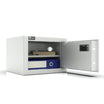
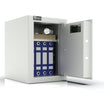
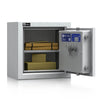


Safe pedestal: plinth for convenient access
 Beratung durch Experten
 Lieferung zum Wunschort
 Fachgerechte Montage vor Ort
Base 10cm (10 x 49 x 41cm)

Base 30cm (30 x 49 x 41cm)

Base 80cm (80 x 49 x 41cm)

Base 50cm (50 x 49 x 41cm)

Plinth 50cm (50 x 57 x 50cm)

Plinth 50cm (50 x 57 x 50cm)

Base 30cm (30 x 57 x 50cm)

Base 30cm (30 x 57 x 50cm)


Safe plinth: bringing your safe to a comfortable height
A safe is rarely located where it is convenient to operate. If it sits directly on the floor, the lower compartments are at knee level, meaning anyone who removes items daily has to bend down every day. A plinth raises the safe by 10 to 80 centimeters, bringing the lock and interior to a height that allows you to stand upright.
The second reason is practical: in cellars, garages, and storage rooms, a safe placed on the floor is likely to be exposed to dampness. A plinth creates space, keeps moisture away from the body of the safe, and makes the area underneath accessible for cleaning.
The plinth is anchored as well
A common misconception first: a plinth does not cost you anything in terms of security. It is built for the anchoring process itself and comes with a pre-drilled hole in the base for this purpose.
The procedure is two-fold. First, the plinth is anchored to the floor, then the safe is bolted onto the plinth from the inside. Both combined is a standardized procedure and is considered professional anchoring. In the end, your safe is just as secure as it would be without a plinth—just higher up.
Which plinth fits my safe?
The footprint is the decisive factor. Our plinths are available in two dimensions, matching the footprints of our product series, and in four heights.
| Height | Footprint | Typical use |
|---|---|---|
| 10 cm | 49 x 41 cm | Clearance from the floor, protection against moisture |
| 30 cm | 49 x 41 cm and 57 x 50 cm | Convenient access to the lower compartments |
| 50 cm | 49 x 41 cm and 57 x 50 cm | Operation while standing, frequent access |
| 80 cm | 49 x 41 cm | Working height, e.g., next to a counter |
Before choosing, measure the footprint of your safe and compare it with the dimensions of the plinth. The safe should rest completely on the surface and not overhang.
What the surface needs to support
A plinth and safe combined exert force on a smaller area than a safe alone. Up to a total weight of about 200 kilograms, this is not an issue in a standard residential building. Beyond that, it is worth looking at the floor level and the proximity to a load-bearing wall. We are happy to advise you on this in advance so that the delivery does not fail due to structural limitations.
Buy a safe plinth at Bremer Tresor
We manufacture our plinths to match our own product series, using the same workmanship and color. If you are unsure which plinth belongs to your model, simply give us the model name. You can find all contact channels on our contact page.
FAQ
Frequently asked questions
A pedestal elevates the safe so that the lock and lower compartments are at a comfortable operating height. It also creates a gap from the floor, which protects against moisture in basements and garages and allows for cleaning underneath it.
No, it just happens in two steps. The pedestal has an anchoring hole in the base and is secured there
That depends on how often you access the safe. 10 cm is sufficient if it is only about the distance from the floor. 30 and 50 cm are the standard heights for daily access, and 80 cm brings the safe to working height.
By the base area. Measure the width and depth of your safe and compare both with the dimensions of the pedestal. The safe should rest completely on it. If in doubt, tell us the model name and we will tell you which pedestal belongs to it.
Yes. The pedestal is placed underneath