




Floor safe: Discreet security for valuables
Order your discreet security solution conveniently online at Bremer Tresor today!
 Fachgerechte Montage vor Ort
 Verankerung durch unser Team
 Beratung durch Experten

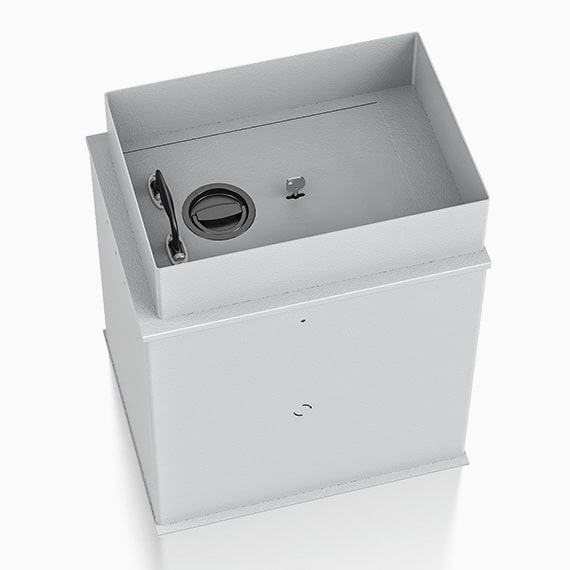
Pan 30 - Floor Safe Class S2 - (33 x 44 x 54cm)
Pan
External dimensions 33 × 44 × 54 cm · H×W×D

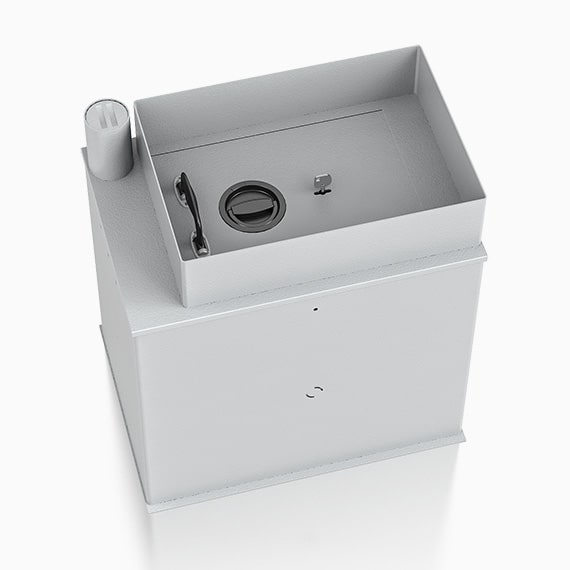
Pan 30 with deposit slot - Floor safe Class S2 - (33 x 44 x 54cm)
Pan
External dimensions 33 × 44 × 54 cm · H×W×D


Planning a floor safe
When planning a floor safe, whether small or large, it is ideal to consider it during the construction phase. This allows for sufficient space to be created for the safe when designing walls, ceilings, and floors.
Additionally, the external dimensions (height x width x depth) and the weight of the safe should be taken into account. It is important to use the external dimensions as the basis for calculation in order to optimally integrate the safe into the floor.
The covering of the floor safe should also be well thought out, for example by using a carpet or a cover plate, to protect the safe while still allowing easy access when needed.
Securing your valuables with a floor safe
When securing your valuables in a floor safe, it makes sense to know during the planning stage which items worthy of protection you intend to store in it later. This allows the internal dimensions, the number of shelves, and their adjustability to be considered accordingly.
The safe security level of the floor safe also plays an important role, as it often influences the amount of the insurance coverage. Common security levels like S1 and S2 make it difficult for unauthorized persons to break open the floor safe and steal your valuables.
Legal requirements and regulations
Please note that special legal requirements apply to certain items if they are to be secured in floor safes. This concerns, for example, narcotics as well as long guns, handguns, and ammunition, for which specific legal storage regulations apply. For storing a large number of items, a vault room, which can be implemented using a vault door, is a suitable option. Furniture safes are also considered built-in safes. These are available in a variety of security levels and sizes.
Installation of a floor safe
The installation of a floor safe requires some preparation and should be carried out carefully. First, it is important to prepare the floor carefully and create a recess that is slightly larger than the external dimensions of the safe. The walls of the recess should be uneven to ensure better adhesion of the concrete. Before pouring the concrete, it is advisable to check all functions of the safe and ensure that the top side (door) is correctly positioned.
When installing, it is crucial to align the floor safe correctly. Ensure that you have the safe anchored. A good method is to place the safe on metal profiles or similar to ensure an even concrete base. During the installation, the safe door should remain closed to keep out dirt and moisture.
Consider floor quality and potential moisture
The concrete used for the installation should meet the strength class C30/37. It is important to ensure uniform concrete quality and to pour the concrete in layers, compacting it carefully to avoid voids. After embedding in concrete, the concrete should be given sufficient time to harden (usually at least 48 hours) before the safe door is opened.
It is also advisable to protect the floor safe from moisture before embedding it in concrete, especially if an electronic lock, such as an electronic combination lock, is used. Sealing the area around the keypad and the battery compartment can prevent moisture from penetrating and damaging the lock.
Comprehensive service for your floor safe
The installation of a floor safe requires care and precision to ensure a secure and effective protective solution for your valuables. If you do not feel confident or do not possess the necessary manual skills, it is recommended to commission a specialist company for the installation to ensure that the safe is installed correctly and meets all security requirements. We would be happy to advise you on how to optimally install your floor safe.
Rely on our top-class safe service and purchase your floor safe from your security expert, Bremer Tresor!
FAQ
Frequently asked questions
A floor safe is embedded into a recess in the floor. This recess must be slightly larger than the safe itself. The safe is lowered into this hole and leveled.
A floor safe itself possesses fire-resistant properties. However, the final level of fire protection depends primarily on the encasement. Consequently, the fire protection is related to the installation. You can find precise information regarding fire protection by referring to fire protection classes.
A floor safe offers a high degree of security for your valuables. Due to the installation in the floor and the anchoring with a concrete encasement, the safe becomes extremely stable and resistant to break-in attempts. The exact security level depends on various factors (e.g., materials, locking mechanism, and certifications), as well as the quality of the installation.
There are several ways to hide a floor safe. One option is to place the safe under a rug or flooring so that it disappears from view. Another possibility is to integrate the safe into a piece of furniture or hide it behind a cabinet or another large furnishing. Furthermore, you can also install the floor safe in a non-obvious area of the room, such as under a removable floor panel or in an inconspicuous corner.