




Wall safe security level B: Quality from Bremer Tresor
 EN-Zertifizierte Tresore
 Versicherbar nach Widerstandsgrad
 Fachgerechte Montage vor Ort
The form could not be loaded.


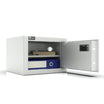
Indra 40S - Wall Safe Class S2 - (42.6 x 42 x 20cm)
Indra
External dimensions 42.6 × 42 × 20 cm · H×W×D


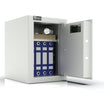
Indra 40 - Wall Safe Class S2 - (42.6 x 42 x 36cm)
Indra
External dimensions 42.6 × 42 × 36 cm · H×W×D


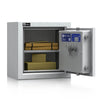
Indra 30 - Wall Safe Class B - (26.6 x 30 x 20cm)
Indra
External dimensions 26.6 × 30 × 20 cm · H×W×D


Indra 20 - Wall Safe Class B - (16.6 x 30 x 20cm)
Indra
External dimensions 16.6 × 30 × 20 cm · H×W×D


Indra 60 - Wall Safe Class S2 - (60 x 42 x 36cm)
Indra
External dimensions 60 × 42 × 36 cm · H×W×D


Indra 60XL - Wall Safe Class S2 - (60 x 60 x 36cm)
Indra
External dimensions 60 × 60 × 36 cm · H×W×D


Indra 80 - Wall Safe Class S2 - (80 x 80 x 36cm)
Indra
External dimensions 80 × 80 × 36 cm · H×W×D


Advantages of a wall safe
A built-in safe offers you several advantages compared to a free-standing safe:
- Even higher break-in protection
- While an unanchored safe can be easily removed and then broken open in peace, taking a wall safe is only possible with great effort. This creates noise and requires a lot of time—risks that few burglars are willing to take.
- Small footprint
- A safe installed completely into the wall ensures that no additional space is required for it.
- Discretion
- A safe is rarely desired as a focal point; hide it discreetly behind a cabinet or picture. A burglar will also need time to find the safe in the first place.
It should be noted, however, that the installation of a wall safe requires effort; it is therefore often carried out during new construction or major renovation work. A subsequent integration of the built-in safe is possible at any time, but it takes more time and must be planned extensively. As a casing, safes with Security Level B generally require at least 100 mm of concrete to ensure optimal security.
Installation
First of all, the chosen location for your wall safe plays a decisive role. It should be hidden enough, but also sufficiently practical. For example, it is a good idea to hide the wall safe behind a cabinet; however, this is only practical in the long run if the back panel of the cabinet has been adapted to be movable. Moving a cabinet to open the safe will prove to be very impractical. A wall painting is a simpler hiding place, but a burglar will check this first.
Outer walls are generally not well suited for installation. Although they have sufficient thickness, the opening here can lead to the wall being less insulated than before and thus cause problems. In the worst case, the structural integrity of a load-bearing wall can even be affected.
Interior walls, however, often fail due to insufficient thickness; in some cases, it will be necessary to build an additional wall to optimally integrate the safe.
To ensure that your safe has been installed securely and no mistakes have been made, installation by professionals is advisable. Our team will be happy to support you in optimally integrating your Security Level B wall safe.
Lock systems
With us, you can freely choose the lock system for your Security Level B wall safe according to VDMA 24992. The decisive factor here is whether you want to choose a version with a key (classic double-bit lock) or with a code (electronic combination lock). Please note that a double-bit lock can quickly lead to devastation in the event of a break-in, as the burglar will search for the associated key. We would be happy to advise you on a lock system tailored to your needs; contact us at any time.
FAQ
Frequently asked questions
B comes from the older classification according to VDMA 24992 and describes a simple security cabinet, not tested according to EN 1143-1.
For general valuables and protection against opportunistic access. Where an insured sum is to be covered, insurers today generally require testing according to EN 1143-1 or EN 14450.
It is walled into a load-bearing wall and sits flush. It is the masonry surrounding it that makes this design secure.